

ChatGPT Has Ads Now. Here’s What They’re Actually Selling.
Unmissable Patterns #2. On the shift from monetizing attention to intent, the hires that told the real story, and what the market is already doing about it. Part 1 of 2.

This week, two AI companies spent millions to fight over whether your thinking should have a sponsor.
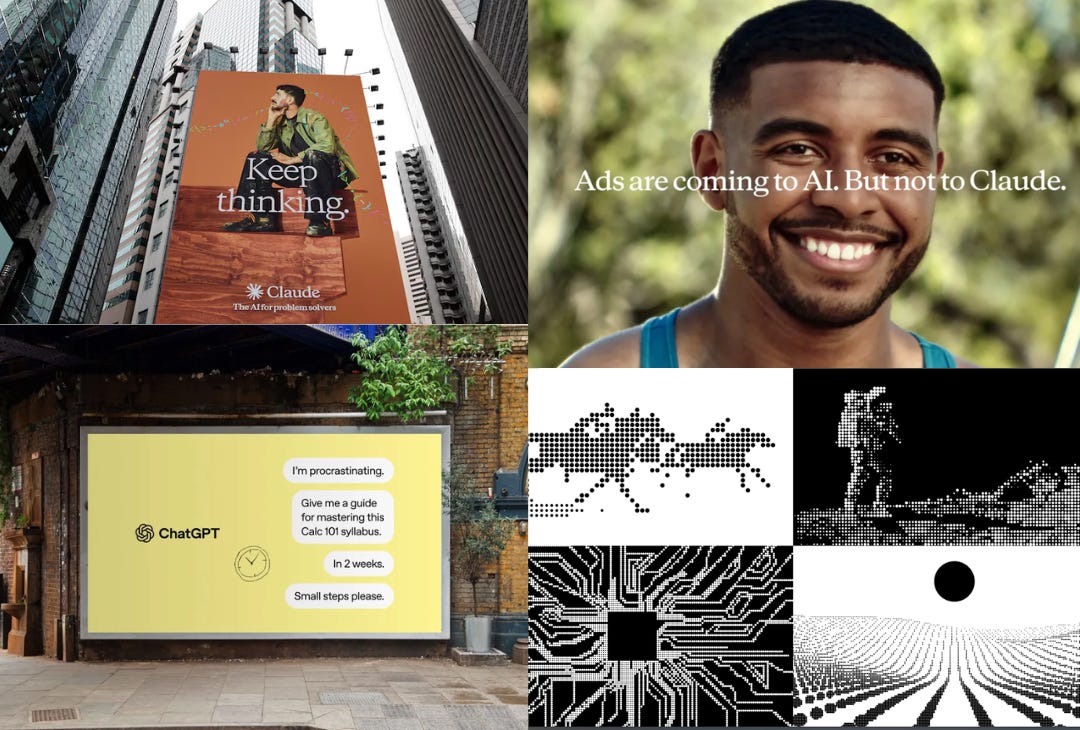
Anthropic aired Super Bowl ads dramatizing what happens when a chatbot mid-conversation pivots into a product pitch, a man asking for help talking to his mom gets served a dating app ad instead. The tagline: “Ads are coming to AI. But not to Claude.” OpenAI’s CEO called the spots “dishonest” and Anthropic an “authoritarian company.” Then he said Anthropic “serves an expensive product to rich people.”
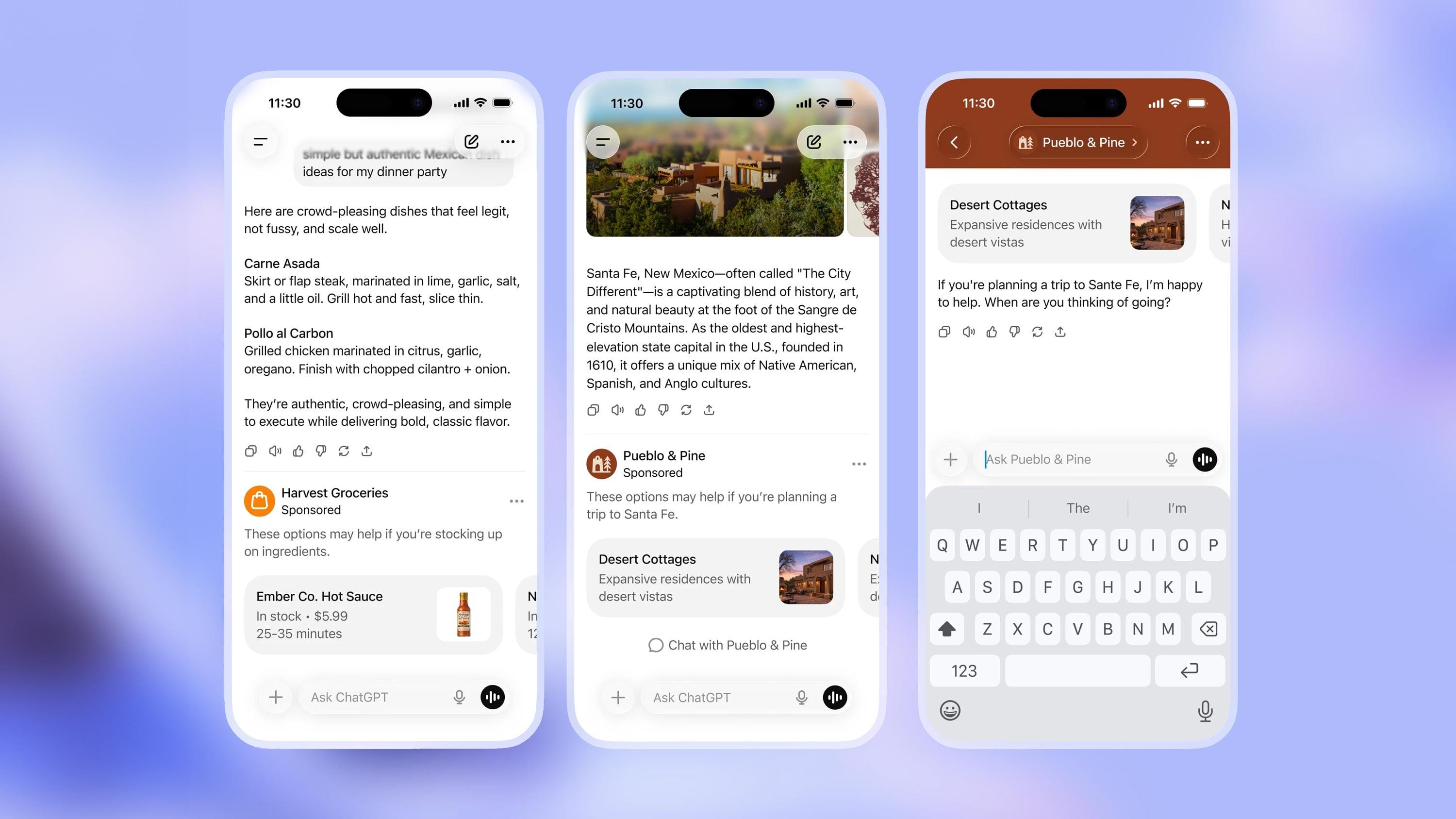
Meanwhile, the ads they’re fighting about are already live. OpenAI started testing sponsored placements inside ChatGPT on February 6th, for free and Go tier users in the U.S. And the details of how they’re doing it tell a more interesting story than either company’s Super Bowl spot.
Twenty Months
In May 2024, Sam Altman told a Harvard audience that the combination of ads and AI felt “sort of uniquely unsettling” to him.
By October 2024, he clarified: “I will disclose, just as a personal bias, that I hate ads.”
By mid-2025, on Stratechery, the tone had shifted. He said he “loves Instagram ads” and that they’d added value to his life.
By January 2026, the ads were live.
Twenty months from “uniquely unsettling” to monetized.
This is a burn rate driving strategy and perception. OpenAI spent roughly $8 billion in 2025 and was burning about $1.69 for every dollar it brought in.The company told investors it could burn up to $115 billion in cash by 2030. Ninety-five percent of its 800 million weekly users were on the free tier. That math was going to resolve itself one way or another.
What’s worth paying attention to here is the gap between what a CEO says publicly and what the financials have already decided. If you’re building products or leading teams that depend on these platforms, I think we have to pay closer attention to the financial reports before the PR announcements.
We’ve Seen This Movie Before
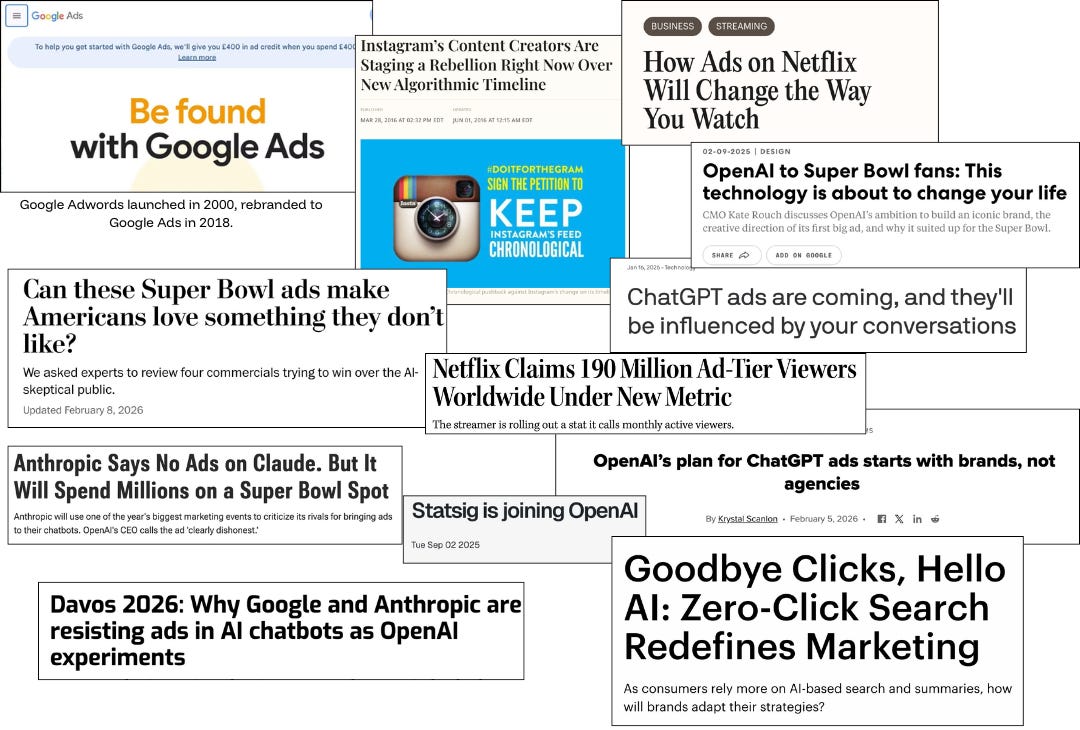
This is the fourth time in twenty-five years that a major platform has followed the same arc: earn trust, grow the user base, monetize the user base, and bet that switching costs hold.
Google launched AdWords in October 2000 as a clearly labeled sidebar. Over the past 25 years, the ads crept into the core results until they became nearly indistinguishable from organic search results. Most users under 30 have never seen Google without them.
Instagram killed its chronological feed in March 2016 to optimize for ad placement. 276,000 users signed a petition. Within weeks, they stopped noticing. The feed they loved was gone. The feed they got was built for someone else’s revenue model.
Netflix is the most useful comparison. Reed Hastings was vocal, no ads, ever. Then Netflix lost subscribers in the first two quarters of 2022. By November, the ad tier launched. Today, more than half of new signups choose the ad-supported plan.
Consumers complain, petition, and then are forced to habituate. And I keep noticing the cycle compresses each time. The outrage gets shorter. The adjustment gets faster. By the time anyone looks back, the previous version of the product feels like a memory, not a standard anyone’s actually holding companies to.
What used to surprise us has now become an expected playbook. Some would argue this is just the nature of the attention economy, wherever eyeballs go, ads follow. Others would call it something closer to manipulative design: the slow embedding of commercial interests into spaces people didn’t realize they’d agreed to share. Both of those things can be true at the same time.
Follow the Hires, Not the Headlines
The ad strategy was visible months before it was announced. It just wasn’t announced with a press release.
In May 2025, OpenAI hired Fidji Simo as CEO of Applications. Before OpenAI, Simo ran the Facebook mobile app during its peak ad monetization years. Then she was CEO of Instacart, where she built out the retail media and data platform. That’s a very specific career arc. You hire someone with that resume for one reason.
Simo was tasked with hiring someone to oversee monetization efforts. In December, OpenAI poached Denise Dresser, CEO of Slack, (longtime executive with Slack parent company Salesforce) to be its chief revenue officer. When you hire a CRO from one of the most enterprise-embedded communication platforms in the world, you’re not experimenting with revenue. You’re building the machine.
In September 2025, OpenAI acquired Statsig for over a billion dollars. Statsig does A/B testing and feature flagging, specifically the kind that measures how much friction users will tolerate before they leave. If you’re building an ad-load optimization engine, it’s essential.
Then there’s Pulse, ChatGPT’s personalized morning briefing feature. You tell it your interests, your routines, your priorities, and it curates a daily summary. It feels like a utility. But the more you tell Pulse about yourself, the more targetable you become. It’s a profiling tool wearing a concierge outfit.
Simo. Statsig. Pulse. They started dropping hints, hiding in plain sight a year before the ads actually showed up.
The Sixty-Dollar Question
OpenAI is charging advertisers $60 per thousand impressions. For context, Meta charges about $20. The only other formats commanding $60 CPM are live NFL broadcasts and the Las Vegas Sphere.
But unlike those formats (and unlike Google and Meta), ChatGPT offers almost nothing in the way of measurement. According to Digiday’s reporting, advertisers in the test will receive view and click-through metrics. No conversion tracking, no pixel data, no retargeting. They can’t measure whether an ad led to a purchase or build lookalike audiences. None of the infrastructure that made digital advertising a performance channel over the last two decades. As one ad-tech CEO put it, by using a CPM model instead of cost-per-click, advertisers are “taking a step back from the conversion metric they care about.“
So what justifies triple the price with a fraction of the measurability?
Proximity to intent. But not the kind we’re used to talking about.
When someone asks ChatGPT to compare health insurance plans, draft a resignation letter, research preschools, or figure out what’s wrong with their knee, that’s not browsing. That’s a decision in progress. And placing an ad next to a decision in progress is a categorically different proposition than placing one next to someone scrolling a feed. On social, you still need to be convinced. In Chat, you’re already convinced. You’re choosing which version to invest in.
Think about what people share with ChatGPT that they’ve never shared with a search engine. They process grief. They rehearse hard conversations. They explore symptoms they’re not ready to bring to a doctor. They work through financial anxiety alongside spreadsheet formulas. The data isn’t a search history or a social graph. It’s closer to a therapy transcript crossed with a strategy session. And now there’s a revenue model sitting next to it.
But I think the conversation here is more complicated than most of the hot takes acknowledge.
Over the past two years, AI search has gutted the organic discovery pipeline that brands spent a decade building. Bain found that 80% of consumers now rely on zero-click AI results for at least 40% of their searches, reducing organic web traffic by 15 to 25%. HubSpot’s organic traffic dropped by as much as 80%. AI scraped brand content to train its models, then the AI-generated answers started replacing the need to visit those brand sites at all. So if you’re a CMO who’s watched that happen, $60 CPM to reach a consumer mid-decision might not look like a premium. It might look like the cost of getting back into a conversation AI displaced you from.
Whether that’s a real opportunity or a toll booth on a road AI paved over is the question product and brand leaders should be sitting with right now.
Perplexity tried a version of this with sponsored answers in late 2024. By mid-2025, marketers flagged limited scale, the head of advertising left, and they stopped accepting new advertisers. Whether ChatGPT’s scale changes that equation or just delays the same reckoning is open.
The Market Is Already Splitting
The competitive response tells you how seriously the industry is taking this. And how much money is behind the positioning.
Companies spent more than $1.7 billion on AI-related advertising last year across TV, streaming, social, and billboards. That number is about to get a lot bigger, because the AI industry isn’t just selling products anymore, it’s selling competing visions of what AI should be. Anthropic’s Super Bowl campaign was a declaration: we’re the AI that doesn’t need to monetize your thinking. One ad agency CEO called it brilliant, tapping directly into the fear consumers already have about chatbots using what people privately confide to sell them things.
And it clearly got under OpenAI’s skin. Altman came back to reframe the entire debate. Accessibility vs. purity. Free AI for billions vs. premium AI for people who can afford it. That framing is going to define how these companies position against each other for the next several years. And it’s worth noting that Anthropic can afford to make the ad-free promise right now because investors are betting on it, the company is closing in on a $20 billion fundraising round at a $350 billion valuation.
At Davos in January 2026, Google explicitly confirmed that Gemini would remain ad-free. Google made $273 billion from advertising in 2024. Advertising is three-quarters of Alphabet’s entire revenue. And they’re choosing to keep their AI product clean. That’s positioning. When your biggest competitor puts ads in their AI, keeping yours ad-free becomes a differentiator you’d be foolish to waste. (It probably helps that Google learned the hard way how sensitive the public is to AI overreach. Remember the 2024 Olympics ad where a dad asks Gemini to help his daughter write a fan letter, and the backlash was so swift Google pulled it from rotation.)
Something is forming here that mirrors what happened in media: ad-supported versus ad-free, where the absence of ads becomes its own quality signal. “Organic” did this for food. In AI, “no ads” functions as shorthand for “no commercial incentive shaping your answers.”
I’m already seeing a more visible conversation about why it matters to maintain accounts across multiple AI platforms. ChatGPT for some things, Claude for others, Gemini for search-adjacent work. The logic is: don’t let one platform’s business model become the single lens you think through, and don’t get locked into one just because it knows so much about you. It’s portfolio theory applied to cognition.
This is the kind of shift I keep working through with brand and product teams, how do you build experiences people actually trust when the infrastructure underneath keeps changing the rules? For the executives navigating signal loss right now, the strategic question isn’t just “should we buy ChatGPT ads.” It’s whether you’re building enough direct relationships with your customers that you’re not perpetually renting access through someone else’s platform. That’s always been the real question. AI just made it urgent.
What We Stop Noticing
The truth is, we’ll adjust. History says we will.
ChatGPT will follow the same curve. The first ads will be clearly labeled, tastefully placed, and subtly persuasive. And then, gradually, they’ll be optimized. The line between answer and recommendation will soften. The suggestions will get more specific. And we’ll stop noticing, because that’s what we do.
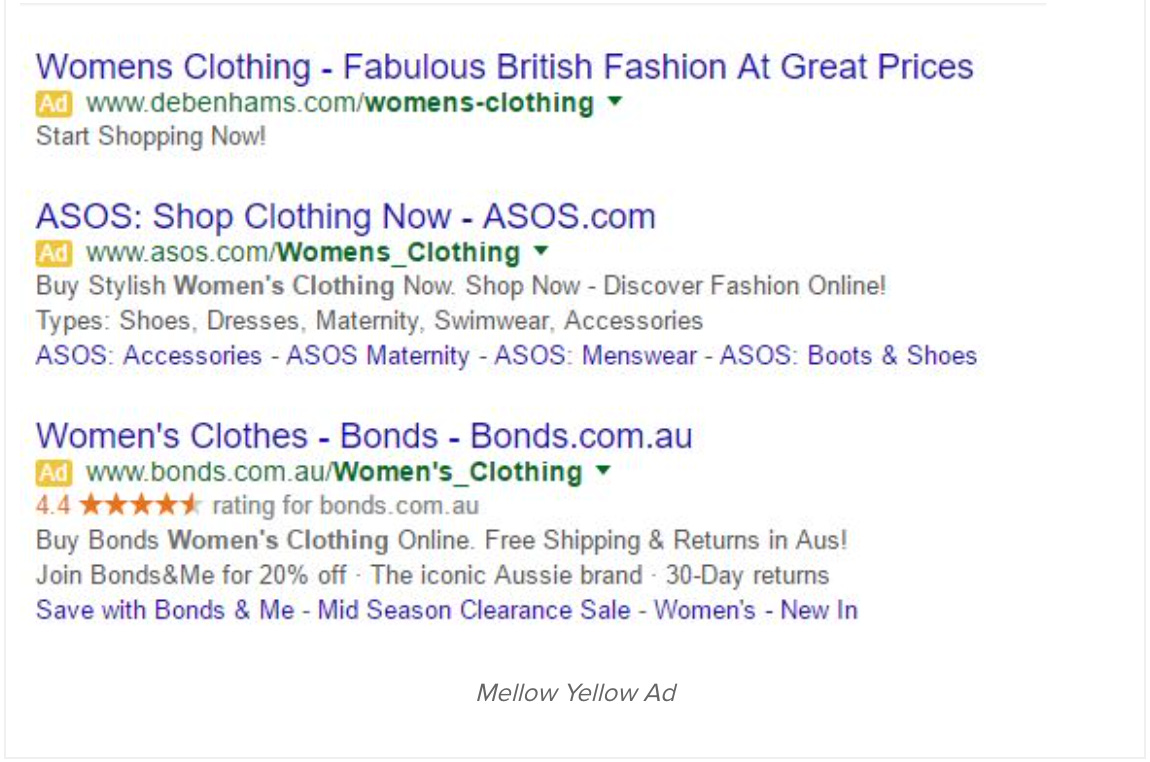
There’s a UX pattern worth naming here. When Google launched ads, they were marked with a green box, a colored background, and a clear label. Over time, the green box became green text, then black text. The colored background disappeared. Favicons were added to organic results so they looked identical to the ad format. Each change was small, defensible, forgettable. Harry Brignull, who coined the term “dark patterns,” pointed out that Google went “from the most transparent search engine on the planet to one where you have to actively slow down to tell ads from real results.” Twenty-five years of tiny adjustments. That’s how it works.
And the early design choices are telling. Ad personalization in ChatGPT is on by default, you have to go into settings to opt out. OpenAI has also confirmed they’re targeting ads based not just on the current conversation, but on your past chats and previous ad interactions. That’s a feedback loop: the more you use the product, the more precisely they can match you to a sponsor. It’s worth noting that this is the same company that, late last year, tested app suggestions inside ChatGPT that users widely mistook for ads and faced enough backlash to pull them. The boundary was already being tested before the official launch.
OpenAI is already being careful about the narrative. Digiday reports that OpenAI is controlling how advertising partners can even talk about the test. Partners need pre-approval on all messaging and are told to frame it as a user experiment, not a product launch. They’re instructed to emphasize that answers aren’t influenced and that conversations stay private. That level of narrative control tells you they know exactly how fragile the trust is.
And here’s the detail I keep coming back to: OpenAI says users will soon be able to ask ChatGPT questions about an ad to help make purchase decisions. Read that again. The ad doesn’t just sit next to your conversation. It enters it. The sponsored content becomes part of the dialogue, indistinguishable in format from the answer you were actually looking for. If you wanted to design the most seamless possible erosion of the line between recommendation and advertisement, this is what it would look like.
The question that keeps pulling at me isn’t whether ads in ChatGPT are good or bad.
It’s what happens when the tool you trusted to help you think is optimized for someone else’s goals and you don’t notice the shift because it happens one small adjustment at a time, until “of course it has ads” feels like something you always knew.
That’s the pattern. And it’s worth watching closely, because this time the thing being monetized isn’t your feed or your watch history. It’s your thinking.
Next issue: Eight days before the ad announcement, OpenAI launched ChatGPT Health and asked users to connect their medical records. Same month. Same executive introducing both. In Part 2, I’m pulling on what happens when the platform monetizing your intent is also the one reading your lab results , while telling advertisers that ads won’t appear near health topics. And Anthropic, the company that just spent millions arguing ads don’t belong in AI, launched Claude for Healthcare the same month too. The question of who you trust with your thinking gets a lot sharper when your thinking includes your health data.
Let me know in the comments how youre feeling after reading this? How are you approaching advertising in Chat GPT?
— Ariba
Resources
On OpenAI’s ad announcement and Altman’s reversal:
On the ad rollout mechanics and pricing:
Digiday: OpenAI’s plan for ChatGPT ads starts with brands, not agencies
PPC Land:ChatGPT ads arrive as Threads expands global monetization
On the hires and infrastructure:
On OpenAI’s financials and burn rate:
On the Super Bowl ad battle:
TechCrunch: Sam Altman got exceptionally testy over Claude Super Bowl ads
Washington Post: Can these Super Bowl ads make Americans love something they don’t like?
On the competitive landscape:
On the impact on brands and organic discovery:
On dark patterns and UX erosion:
On historical platform comparisons:
This is an excellent analysis and snapshot! Thank you for this!