

What I Shared at Leading Design London about Leading Through Uncertainty
Most teams treat misalignment as a people problem. It's often a mental model and language problem.

Someone asked me after my talk: ‘How do you get leadership aligned when everyone thinks they already are?’ That question came up in different forms all week at Leading Design London, where I spoke on “How to Lead with Momentum When the Path Isn’t Clear” and joined two panels with incredible leaders.
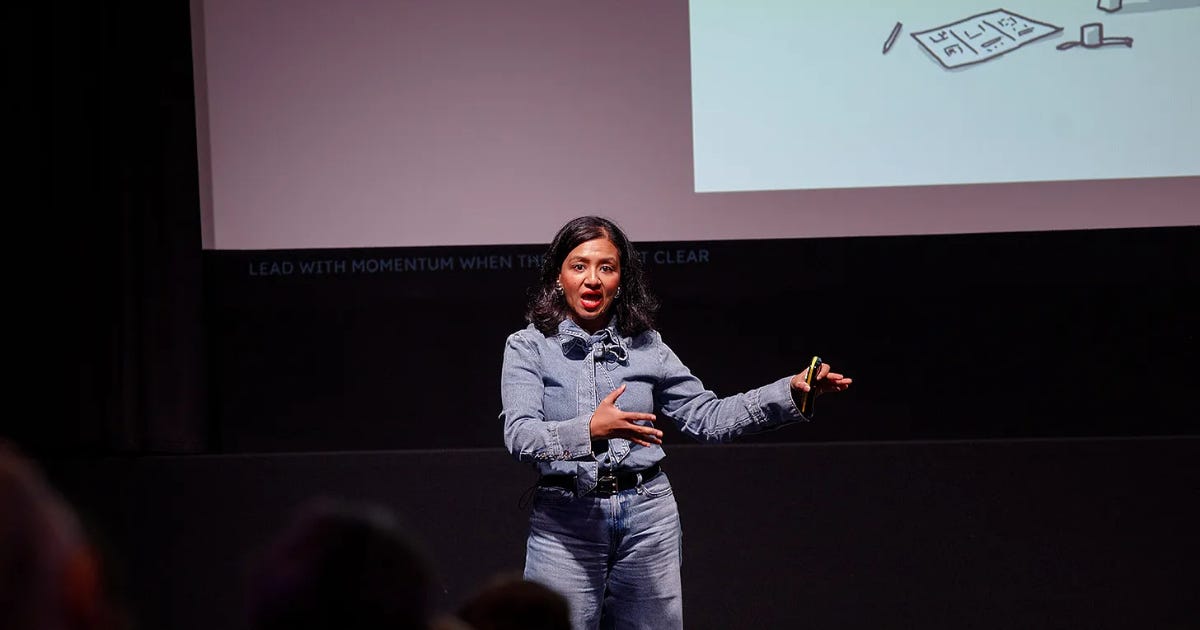
It was interesting to see what themes kept emerging across sessions, side conversations, and the questions leaders were asking each other. None of it was about tools or methodologies. It was about the systems we lead inside, the power they hold, and how quickly those systems evolve while our shared language does not.
Across talks on trust, team dynamics, process, and AI, one thread kept resurfacing:
Leaders are trying to act with responsibility, trust, and conviction while the path ahead refuses to fully reveal itself.
That’s what made the week powerful. This conference has always been a place where leaders drop the performance of certainty and name what’s actually hard: making sense of the gray together.
It’s also the exact space my talk explored: how we create momentum when the path isn’t clear, and why shared language is the most underused leadership tool we have.
This conference has mattered to me since I first attended in 2019. There’s something grounding about being in community with leaders who aren’t pretending to have it all figured out, but who are genuinely committed to making sense of the gray together. Strong curation and thoughtfulness by the conference hosts Rebecca Groves & Louise Ash. They’ve opened up presale tickets, if you’re interested.
The Confusion Isn’t Confusion
Farnam Street describes mental models as the internal frameworks we use to make sense of the world. They’re efficient, but they’re not neutral. They shape what we notice, how we prioritize, and how we interpret risk. (Their Mental Models Handbook is worth the read if you want to go deeper on how these invisible assumptions shape decision-making.)
Inside an organization, this shows up everywhere.
Two people say “urgency” and mean completely different things. A team discusses “impact” with five competing definitions in the room. Leaders evaluate an idea using entirely different success criteria.
I’ve seen a CEO forward a competitor’s AI launch with just a link, no context. Within 48 hours, five teams had spun up competing plans, each solving for a different version of what that email meant.
The confusion leaders feel isn’t actually confusion. It’s the collision of multiple mental models.
Different assumptions about what matters. Different senses of risk and experiment. Different expectations of what “progress” should look like. Different reads on where AI sits in the stack — threat, tool, accelerant, or unknown.
I’ve seen this pattern play out across industries and roles. A CFO and a designer can sit in the same meeting, hear the same brief, and walk away with completely opposite interpretations of what success means. The friction isn’t about intelligence or skill. It’s about operating from different invisible frameworks.
The moment work actually accelerates? It’s when we stop trying to solve the problem and instead surface the assumptions underneath it.
Once the underlying models get named out loud, everything shifts. Not because people suddenly agree, but because they finally understand what they’re disagreeing from.
A few things I’ve learned the hard way
Momentum comes from shared framing of the problem, not faster solutions.
Small experiments create more clarity than long plans.
You can’t align people without surfacing their assumptions first.
Teams don’t need a hero with answers. They need conditions to think and build together.
But here’s the thing about co-creation: people value what they help build. The IKEA effect is real. It’s not just about buy-in. It’s about ownership. When your team helps shape the system, they’ll protect it, evolve it, and move faster inside it.
Amy Edmondson’s work on psychological safety explains why this matters: teams who can admit uncertainty and experiment in public learn faster than teams who can’t.
This was the foundation for the Momentum Operating System I shared — a rhythm for leading through uncertainty by creating shared language, shared direction, and shared learning loops.
The frameworks typically built for ‘change management’ assume the change ends and a level of assurance is reached. But the gray space isn’t temporary anymore, it’s the operating condition. That’s why this work matters.
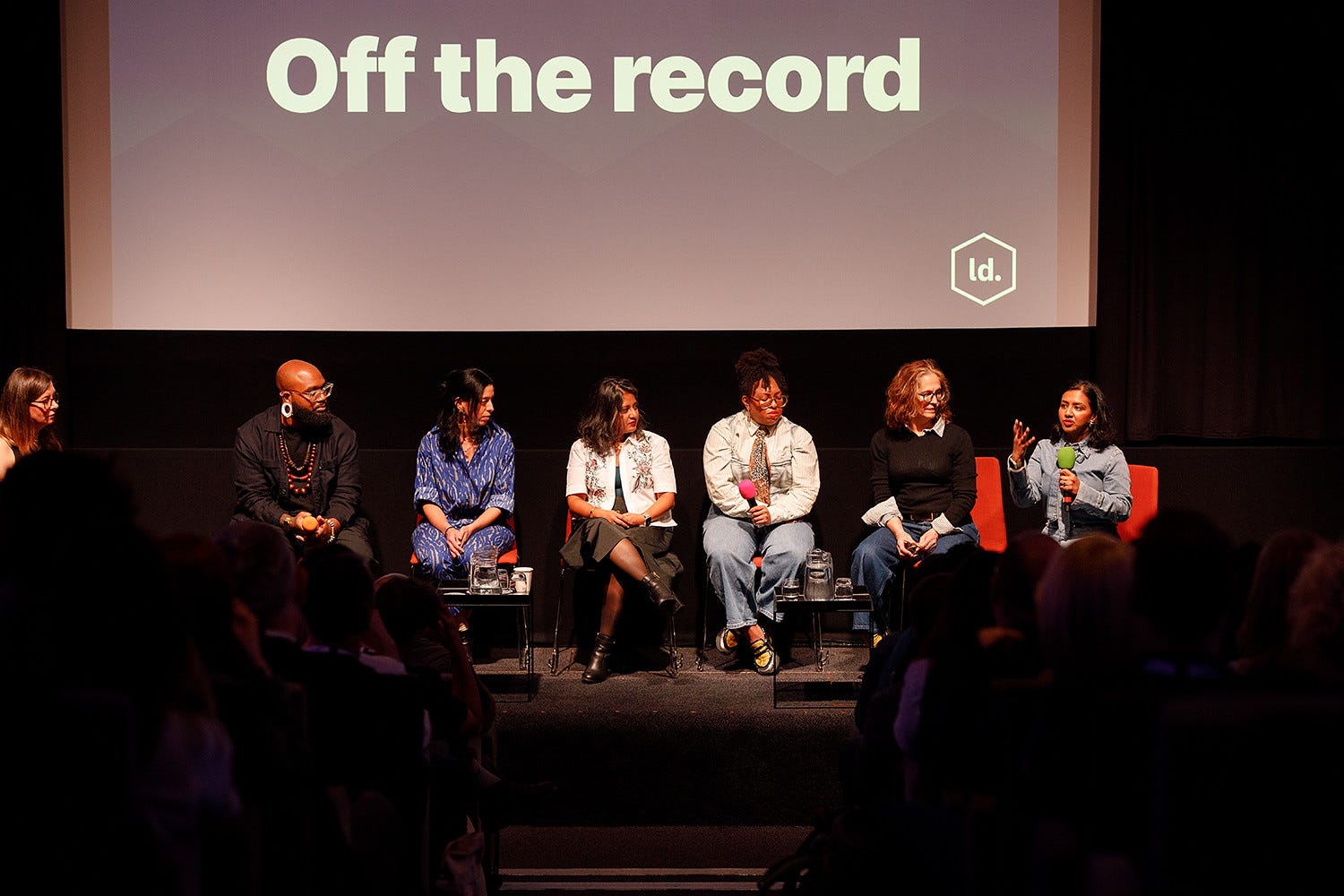
What I Learned From the Conference
The talks and panels didn’t just reinforce what I’ve been seeing, they challenged me, added layers, and gave me new language for things I’ve been feeling but hadn’t named yet.
TB Bardlavens reframed leadership as something you design, not perform. His focus on consequence, equity, and systems that distribute power stayed with me. It made me think about how co-creation isn’t just a nice-to-have, it’s a structural choice about where power lives in an organization.
Dalit Shalom brought precision to what trust means in an AI-powered world. Her point: trust isn’t created by the technology. It’s created by clear, aligned human behavior around transparency, reliability, and integrity. That’s the part that matters as AI reshapes what “experience” even means.
Venessa Bennett challenged the idea that clarity comes from the environment. Leaders must create internal stability while the world remains volatile. Her point landed hard: you can’t outsource your operating system to external certainty. Waiting for conditions to settle is a losing strategy.
Mary Lukanuski named a structural shift I’ve been feeling but couldn’t articulate: AI is splitting design into “guardrail designers” and “problem-definition designers.” This isn’t theoretical. It has real implications for hiring, career progression, and how we build capability inside teams.
Jonas Grinevičius mapped how design’s value changes as companies grow, contract, or reorient. His point was pragmatic and necessary: leaders have to recalibrate what “impact” looks like as conditions evolve. You can’t lead with last year’s success metrics.
Daniel Burka pushed the room to think beyond craft. The responsibility of design extends into the world the work touches, not just the product it produces. He asked us: what problems do we really want to solve in our lifetime? That ethical thread ran through the entire conference.
What I’m sitting with now: everyone is navigating systems where people interpret the same work through completely different lenses. And I’m realizing more and more that the friction isn’t about skill or intent. It’s about whether we’ve built shared language for what we’re actually trying to do.
Two Questions to Sit With
What tension in your team right now feels like confusion, but might actually be the collision of different mental models?
And what is one conversation you could start this week to surface those assumptions?
Because momentum doesn’t come from certainty. It comes from clarity, co-created in real time.
The gray we’re all leading through? It’s not going away. But the leaders who thrive aren’t waiting for the path to reveal itself. They’re building shared language that helps everyone move together, even when no one can see what’s next.
Reply in the comments and tell me: what’s one assumption your team is operating from that no one has said out loud? I read every response.
Further Reading: Resources for Leading in the Gray
On Mental Models & Framing:
Farnam Street - Mental Models Handbook: A grounded introduction to the invisible assumptions that shape how teams interpret the same problem differently.
Dave Snowden - Cynefin Framework: For leaders navigating complex environments where certainty isn’t available and linear plans fail.
Stephen Bungay - The Art of Action: A practical lens on friction, misalignment, and why intent and action drift apart inside teams.
On Prototyping for Clarity:
Peter Sims - Small Bets: Why small, low-risk tests create more clarity than big, slow plans.
Teresa Torres - Continuous Discovery : For leaders trying to shift from “plan, then build” to “learn, then commit.”
Melissa Perri - Escaping the Build Trap: A reminder that building faster isn’t the answer when you haven’t aligned on what problem is real.
On Co-Creation & Psychological Safety:
KA McKercher - Beyond Sticky Notes: is a practical guide to the mindsets, methods, and movements of co-design.
Amy Edmondson - Psychological Safety Research: The foundation for teams who need to experiment, admit uncertainty, and learn in public.
John Cutler - The Beautiful Mess: Because leadership is less about control and more about understanding the messy system you’re operating in.
Priya Parker - The Art of Gathering: For leaders who want to design meetings and offsites that create genuine connection and shared purpose, not just attendance.
On Responsible AI & Design:
Sasha Luccioni - AI Sustainability & Responsible AI: A sharp, culture-conscious take on responsibility in AI systems and the cost of unexamined choices.
Dr. Joy Boumawini - Unmasking AI: The technology of the future is bringing us back to the inequality of the past, but we can still prevent AI from amplifying discrimination.
The Algorithm Justice League - raises public awareness about the impacts of AI, equip advocates with resources to bolster campaigns, and galvanize researchers, policymakers, and industry practitioners to prevent AI harms.
On Leading Design, the conference is happening again in London in 2026, and you can snag super early bird tickets now.
P.S. If you’re interested in having me speak about my Momentum Operating System, reach out here.