


What happens when you stop talking about culture and start designing it like a system?
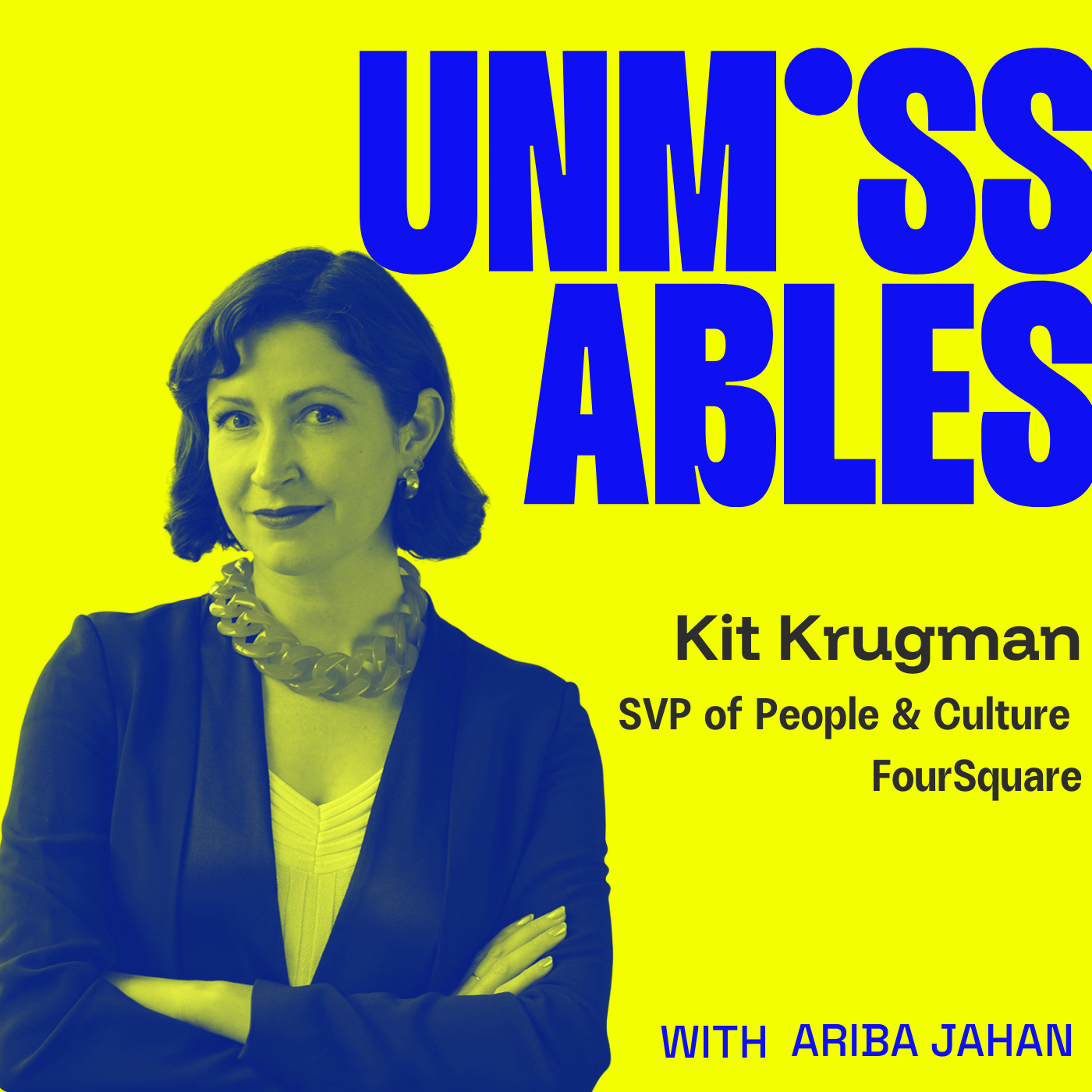
In this episode, I talk with Kit Krugman, SVP of People & Culture at Foursquare, about what it actually takes to build organizations that move fast without burning people out. Kit spent years advising companies like LinkedIn, Microsoft, and CHANEL on organizational design at co:collective. Now she’s doing the work from the inside—redesigning how Foursquare operates at the level of behaviors, feedback loops, and everyday decisions.
We dig into how she audited Foursquare’s performance system and found a “collection of parts” instead of an ecosystem. How her team moved from annual reviews to real-time, peer-based impact tracking. What it looked like to return to office three days a week and what the data actually showed (an 83% jump in cross-functional collaboration). And the provocative experiments they’re running: stripping out meetings, flattening structures, and letting people feel what’s missing before adding it back.
Kit doesn’t treat culture as a brand exercise. She treats it as a behavioral system, one you either design intentionally or inherit by default.
Listen Now: Spotify | Apple Podcasts | YouTube
"You have to be negotiating the value proposition with people on a daily basis, not a macro basis. Every single conversation as a leader is explaining why the work we're doing is important." — Kit
What we explore in this episode
Why the behaviors your system rewards are your real culture
How Foursquare shifted from effort tracking to impact tracking
What Kit learned from auditing who was succeeding and who wasn’t
The tension between trusting people and holding them accountable (especially with RTO)
Her “Maslow’s hierarchy” of people practices and what self-reinforcing culture actually looks like
A reframe on burnout: it’s not about hours, it’s about disconnection
Why storytelling is context, and how micro-narratives shape whether people feel valued
The career move everyone called a dead end that changed everything
Follow along
02:04 – What Foursquare does today
06:03 – From advisor to operator
09:58 – What's breaking inside companies right now
14:35 – The 83% collaboration jump
15:49 – Defining culture: behaviors rewarded and repeated
17:47 – Culture debt
21:55 – Redesigning performance at Foursquare
29:11 – Maslow's hierarchy of people practices
31:01 – You can't coach speed
40:11 – The provocative experiments
46:07 – Rapid fire + the dead-end job that changed everything
49:48 – Sturdy leadership
Takeaways
Your performance system is your culture made visible. Kit’s working definition: culture is the behaviors rewarded and repeated in the system. Want to understand your culture? Look at who’s succeeding and who’s not. That’s the audit.
You can’t coach speed, you have to architect it. Telling someone to “go faster” doesn’t work. What works is context (why this matters), removal of friction (what’s slowing them down), and clarity about outcomes. Speed is a design problem, not a motivation problem.
Culture debt is real and harder to see than tech debt. It accumulates when what you say doesn’t match what you do. The gap between explicit values and implicit behaviors creates drag, frustration, and internal antibodies that work against your goals.
The destination is a self-reinforcing system. Kit’s Maslow’s hierarchy of people ops: first, get the functional stuff working (payroll, onboarding). Then support growth and development. Then connect principles to behaviors. But the pinnacle? Other people enforcing the culture, not you.
Burnout isn’t about hours. It’s about disconnection. When people feel isolated, when their work doesn’t matter, when no one cares, that’s when burnout happens. High expectations in a context of energy, meaning, and collaboration can be invigorating. The hours-worked framing misses the point.
Trust works both ways. The biggest RTO challenge wasn’t getting people back, it was peer accountability. People who changed their lives to come in wanted others held to the same standard. Inequity in enforcement breaks trust faster than the mandate itself.
Signals to watch
Performance systems are becoming peer-driven. Tools like Confirm are formalizing network-based feedback, lightweight surveys that map who’s influencing, energizing, and delivering. Impact is validated laterally, not just top-down. Watch for more orgs ditching annual reviews in favor of continuous, project-based loops.
Culture debt is entering the leadership lexicon. Tech debt is familiar. Culture debt is the gap between stated values and lived experience and it creates organizational drag just as real as legacy code. Leaders who can diagnose it (and close it) will have an edge.
Flattening is getting more intentional. Foursquare isn’t just removing layers, they’re observing what breaks. The question isn’t “should we have managers?” It’s “what were managers actually doing that we need to replace?” Expect more orgs to experiment with stripping back structure and selectively rebuilding.
“Sturdy leadership” as a frame. Kit borrows from Dr. Becky Kennedy’s “sturdy parenting” concept. In times of radical change, leaders who can hold steady—emotionally regulated, boundaried, present, become anchors. This language is starting to spread.
What to try this week
Run a quick culture audit. Look at your last round of promotions or recognition. Who got rewarded? For what behaviors? Does it match what you say you value? The patterns tell you more than your values deck.
Remove one recurring meeting and watch. Don’t replace it with anything. Just observe: where does confusion surface? What do people actually miss? That’s data about what your rituals are really doing.
Track impact, not effort. For one project this week, ask: what moved? Not “how many hours did I spend” but “what’s different because of this work?” Start building the muscle.
Name the story. Kit talks about micro-narratives, the internal story people tell themselves about whether they matter. As a leader, what story are you reinforcing in your 1:1s, your Slack messages, your standups? Is it the one you want?
Guest Bio
As the SVP of People & Culture at Foursquare, Kit Krugman leads Foursquare’s approach to people innovation and organizational design. She leads the development of Foursquare’s team functions with a particular focus on building the organization as a strategic multiplier.
Prior to Foursquare, Kit built and lead the Organization & Culture Design at co:collective, a creative & strategic transformation consultancy. Kit helped leaders build innovative organizations at scale: she has worked with start ups, non-profits and large organizations like IBM, LinkedIn, and Microsoft on future of work initiatives, community, culture and org design.
Kit has been involved in WIN since the early days: first, as a WIN Ambassador, then as the President and Chair of the Board for 2 years and finally as the interim Global Executive Director for a year before joining the board to support development efforts. Working alongside the incredible WIN global leadership team has been one of the most powerful learning experiences of her life and she’s thrilled to continue supporting the team and the impact WIN drives.
Kit is deeply committed to gender equity and the policies and programs that support the cause. She is a vocal advocate of gender equity, inclusion and change leadership: she has been published by Quartz, INC, Huffington Post, and Fast Company and spoken at Adobe’s 99U, DisruptHR, Talent2030 and World Water Week.
Kit holds a masters in Organizational Psychology & Change Leadership from Columbia University, a B.A. in Literature and Studio Art from Yale University and is a certified yoga teacher.
Mentioned in this episode
Kit’s article: Culture Isn’t the Warm-Up Act for Performance
Confirm – performance platform
Dr. Becky Kennedy – Good Inside
Tim Ferriss podcast on “sturdy parenting”
Where to find Kit Krugman
LinkedIn: linkedin.com/in/kitkrugman
Where to find Ariba Jahan
LinkedIn: /aribajahan
Instagram: @ariba.jahan
Newsletter: unmissableswithariba.com
Enjoying Unmissables? A quick ⭐⭐⭐⭐⭐ on Spotify + a review on Apple helps more people find the show. Thank you! 🫶🏽
Note: Kit and I sat down to record this conversation in 2025.


