

Cognitive Endurance: Reclaiming Our Agency in the Age of AI
Nine principles for thinking, creating, and tending our mind palace.

Hi! I’ve spent the last six months thinking about how we work with AI without gradually outsourcing the parts of ourselves we value most. In part 1 of my Cognitive Endurance series, we talked about mindset. In part 2, we’re going deeper into how that turns into a daily practice and operating system. Subscribe & follow along for more of my thoughts on technology, consumer behavior, cognition & society.
There’s a concept older than computers, older than the internet, older than any technology we’re currently debating. The ancient Greeks called it the method of loci. Today, many people know it as the mind palace (thanks Sherlock Holmes). The idea is simple: everything you’ve learned, observed, felt, and lived becomes part of the architecture of your mind. The more deliberately you tend that architecture, the more powerfully you can think.
Somewhere along the way, we started calling all of that, “context.” As if decades of lived experience, grief, sensory memory, family history, and instinct were just information waiting to be pasted into a prompt.
But your mind palace is not simply “context”. It’s textured, woven, multisensory, and alive in ways that don’t compress into a markdown file. It’s the smell of a place you haven’t been in twenty years, triggered by the scent in a restaurant you walked into last night. The thing someone said at a dinner in 2019 that you’re suddenly connecting to a point a speaker made on stage. The feeling in your body when you made your first very hard decision, which then shaped how you manage your nervous system through stressful interactions. The way your grandmother cooked, the artifacts that were preserved in your family, the knowledge that was passed down through relationships, practice, and presence. None of that is in a prompt window, a markdown file, or a model’s training data.
See, models are trained on what has been digitized—the scraped, the posted, the scanned, the recorded collections of text, images, audio and video. They don’t know the texture of a painful breakup, the unwritten rules of a family kitchen, ancestral knowledge, oral traditions, or the cultural documentation of communities that were never digitized. Which means your mind palace contains combinations of memory, emotion, instinct and action accumulated over a lifetime, that no models can access. And I find that incredibly hopeful. I, for one, would like to keep my mind palace flourishing and mine.
We remember, feel, act, and are changed by the consequences of those actions. And it’s the reason the most original thinking, unexpected connection and innovative solution, the thing that didn’t exist before you made it, has to come from you.
You also get to decide how much of your mind palace the machine ever needs to know. Part of tending it is being its gatekeeper from LLMs.
AI output can be an input, something you consider, react to, investigate, and build from, versus treating AI output as a final output, something you release to the world as is. The first is a way to feed your palace, the second bypasses it entirely.
This deliberate choice means certain things take longer, and if in that process my mind palace gets to grow new rooms, and pathways, great.
If the mind palace is something we build over a lifetime, then it deserves deliberate maintenance. That’s what Cognitive Endurance has become for me, a practice for tending the conditions that allow original thinking to emerge. Over the last six months I’ve identified nine principles to strengthen my own cognitive endurance, grow my mind palace, and nurture my relationship with my own thinking, while working with AI. I’m sharing them with you as an invitation to borrow, remix, and add to them. And in that process, I’ll let you know how mine evolve.
The Cognitive Endurance Principles
Domain 1: Live Outside The Algorithm
The most powerful thinking you’ll ever do happens before you write a prompt. It’s in what you notice, what you refuse to let an algorithm choose for you, the friction you protect on purpose because it’s building something a shortcut can’t.
Principle 1: Widen Your Surface Area for Creative Collisions
My best thinking rarely happens at my desk in front of a computer, nor does it feel valuable in the moment. It often happens when two unrelated things collide inside my head, stewing for a while before it makes any sense. Widen your surface area and you increase the odds of stumbling onto something unexpectedly inspiring: an unfamiliar place, someone outside your day-to-day, a book recommended by a librarian, or the person browsing the shelf next to you.
At an AI conference recently, I met a woman who works as a death doula (which I wouldn’t have known by her nametag). So of course we had lunch, and while she talked about grief and end-of-life work, I caught my own brain starting to connect it to my lived experience: how I was grieving past versions of myself, the identity shift of becoming a mom and caregiver to sick parents. I wouldn’t have ever made that connection if I didn’t sit down to talk to a death doula.
For me, it’s important to stay the kind of person who can still be changed by one conversation.
So yes, make time for the AI Ethics event, but also the sewing class, the dog walk with the neighbor, and a random conversation with the waiter about the history book they’ve been reading.
If the only thing you consume is AI Twitter, you’ll sound like AI Twitter. You can’t predict which interaction will give you something worth holding on to, but you can widen the field and let the creative collisions find you.
~ Who’s the most unexpected person you’ve talked to this month? What’s the most out-of-your-discipline thing you read this week, and what did it inspire?
Principle 2: Stay Close to the Problem
AI has access to more information than you ever will.
But can AI ever have proximity to pain? Proximity to uncertainty. Proximity to the moments where people don’t yet have language for what they’re experiencing.
A product I’ve been building for mothers came from exactly that, from spending a lot of time helping moms-to-be prepare for their birthing experience, and then getting 3 am voice notes from new moms crying while breastfeeding. Only I could have had that idea because only I had lived those moments.
A model trained on the internet wasn’t on those calls. Most of that pain lives in voice notes and crying hugs, not published articles.
That’s why I still care more about my own ideas than AI’s. I try to catch them early, a voice note, a sticky note, a long walk with Wispr Flow or Granola. This creates a feedback to my own mind that I care enough about my own thinking enough to let it pass through my own mind palace before I ask AI what it thinks.
The most valuable ideas won’t come from better prompts. They’ll come from staying close enough to people, problems, and lived experiences that AI can never fully know.
~ When did you last write down an idea before asking AI what it thought?
~ When did you last take an early idea of yours seriously enough to share it with enthusiasm?
Principle 3: Let Good Friction Nurture Your Focus
The obsession with frictionless experience is not a universal good. When we over-index on frictionless, it can become dark design patterns, like the infinite scroll or autoplays, or default opt-ins for data sharing.
It’s a design choice that assumes the person using the product benefits from removing effort. But effort, applied to the right things, is how your mind palace gets built. The friction of reading something dense, sitting with an argument that won’t resolve into a neat statement – that’s the point.
I was listening to a recent conversation between Baratunde Thurston and Shae O. Omonijo, and I loved that they also talked about intentionally adding friction between you and AI. Shae writes morning pages by hand, and Baratunde is relearning French by writing it out, not through chatbots. I’m purposely going back to bullet journaling and doing more writing by hand, so I have a better sense of what I’m thinking, feeling, and putting on my plate.
We spent twenty years treating friction as bad design. But learning, craft, intimacy and mastery all depend on the right kinds of friction.
So the practice is twofold. Remove bad friction. Protect good friction. Keep the friction that would change your choice, force a skill to be practiced, or require deliberate thinking and learning. Nobody else will make that distinction for you. Very few products are being designed to invite good friction into your life. That design work is yours.
~ Name one thing you’ve been automating or letting AI handle that you didn’t notice started changing how you think about it.
~ What’s one piece of that process you could take back, even partially?
Domain 2: Extend Your Intelligence
You and the machine, figuring out where it earns a place in your work and where it doesn’t, and whether you’re still the one making that call once it’s sitting right there with you. I think of AI less as artificial intelligence and more of extending my own intelligence and intelligence of everyone it has been trained on.
Principle 4: Treat Your Own Context and Process as IP
Your process is IP for the same reason your mind palace is yours: AI is trained on what’s already out there, what got published, scanned, posted. Your process, your circumstances, the specific way your lived experience shaped how you got somewhere, changed your mind, collaborated with someone – none of that is accessible to it.
In a world where everyone has the same tools that are trained on the same data and can run similar prompts, the irreplaceable thing isn’t the output. It’s how you got there. Your way into a problem, the order you ask your questions in, the frameworks and approaches you develop, and the connection you made because of a combination of experience and context nobody else has. That process is the intellectual property.
This series started with metacognition, noticing what was happening to my own thinking as I interacted with AI in my work and across platforms, and writing it down before I knew what I was going to do with it. The specific way I went about noticing, researching, developing the framework, talking about it with peers, and revising it are unique to me. The architecture of this piece and why it exists came from a process only I could have run.
Jack Clark, the cofounder of Anthropic, said something at a recent fireside chat with Sam Kimbriel that stuck with me: in ten years, the things you chose not to feed AI, the information you kept to yourself, may be part of what still makes you distinct. You don’t have to give it all away just because you can.
Everyone says AI democratizes outputs. But, what becomes scarce?
I think it’s our contextualized process.
What part of your work looks obvious in hindsight, but only because nobody else saw the number of decisions and actions that got you there?
If someone tried to perfectly copy your output, what part of your process would they still miss?
Know someone who’d love this article on Cognitive Endurance and protecting our thinking ? My work spreads through thoughtful people like you sharing it with another friend. Thank you!
Principle 5: Define Where AI Belongs and Where It Doesn’t
Where AI belongs isn’t one universal answer. It depends on the container you’re in, and each one comes with a different amount of agency to exercise.
Sometimes someone else decides for you, whether that’s an employer demanding AI usage or a client who has specific tools you must use. I was on a call with a friend who suddenly said, “Hold on, I have to quickly use our AI agent so it shows I’ve used it today.” She wasn’t using it because it was helpful; she was using it because she was being tracked. This is AI compliance dressed up as AI upleveling.
Sometimes the decision is made by the products you already use. Google Search is now Gemini, immediately triggering a chat interface when you try to search for something. Instagram generates reel summaries creators never consented to. Apple summarizes your texts and notifications. AI became the default before we’ve consciously decided on where to let it in.
Then there’s the container where you have the most agency: your own life. This series is my attempt to define where AI belongs in mine. I use it to help me prototype, organize information, process my inbox or explore unfamiliar topics. As you can already tell, my ideas still begin with me.
Your boundaries don’t have to look like mine, or anyone else’s. They just need to be your boundaries.
~ Where in your work and life does AI show up because you chose it vs. where has it become AI theatre forced by someone else? What level of agency do you have in the latter scenarios?
~ What are some rules you want to create for yourself about where AI gets to be and where it can’t?
Principle 6: Be the Evaluator
Judgment used to belong to experts. Increasingly, our job isn’t generating answers—it’s evaluating them, whether they come from AI, the internet, or each other.
A while back I ran an experiment. I gave the same prompt to Claude, ChatGPT, and Gemini, then showed each model what the others had written. Instead of engaging with the argument, Claude immediately recognized Gemini’s style and dismissed it. It wasn’t evaluating the argument, it was evaluating the source. When I pushed back that it was discrediting based on the source, the conversation shifted and Claude started engaging with the answers.
Whether the models agree or disagree tells you less than you’d think. They’re all trained on similar data, so agreement can just mean a shared blind spot, and disagreement can just mean one of them was trained to write differently from the others. Evaluating is deciding what’s worthy of someone else’s time and attention. AI is going to produce slop. It’s on us to decide whether that slop stays part of our process or becomes someone else’s problem.
Either way, the job is still ours: Is it accurate? Is there bias? Does it match what I was trying to do? Am I asking someone else to read slop?
~ When did you last tell a model it was wrong, and were you right? And before you send something out, have you actually made it good, or just made it look finished?
Domain 3: Shape the Future Intentionally
The future gets talked about like it’s already decided: AI replacing you, the timeline set, your only choice being in or out. It isn’t decided. People built the systems we’re living inside of, which means people can still shape what comes next, but only if they stay in the room instead of opting out or scrolling past.
Principle 7: Design the Loop
I remember getting on a call where everyone had run their own deep research market analysis going into it. We went around sharing findings, insights, and ideas. It was also clearly shaped by whatever each person had fed their own model. After the call, we all went back to our own AI workflows and had to reconcile everything manually, the way we always have.
That’s the design we’re all living in right now: everyone running their own AI workflow, then bringing the output to the group and calling it collaboration.
Most proposed solutions treat this as a tooling problem: get everyone onto the same platform or shared workspace. But tools don't decide which interpretation is right or where the team goes next. That's still a human decision. Designing the loop means deciding, together, where AI belongs instead of assuming everyone is using it the same way.
The same thing happens between organizations and the people they serve. It’s tempting to ask AI what customers think instead of asking customers themselves. AI can summarize interviews, identify patterns, and help make sense of what you’ve learned. But it can’t replace the conversation that generated those insights in the first place. If your understanding of the people you’re building for comes entirely from a model, you’ve broken the loop.
Leading the loop means staying close enough to the people you’re building for that no summary could replace it.
~ Does anyone on your team actually know what everyone else is doing with AI?
~And where have you swapped an actual conversation with a real person for a good enough summary of one?
Principle 8: Question the Default Narratives
I was on a NYTechWeek panel recently, and we were asked: why are women behind on AI? I’ve heard versions of this question a lot. And every time I hear it, I think: behind what, exactly? Tools built without us, trained on data that flattens us? Getting more women to adopt those tools is market expansion dressed as equity. The framing assumes women need to catch up, based on a usage metric that doesn’t tell a complete story. Many women are leading AI: Mira Murati, former CTO of OpenAI and now founder and CEO of Thinking Machines Lab. Daniela Amodei, cofounder and president of Anthropic. Timnit Gebru, who’s spent years forcing the field to reckon with bias and harm in these systems before anyone wanted to hear it. Safiya Noble, whose research on algorithmic bias in search shaped how an entire generation thinks about this.
That’s what a default narrative does. It decides what counts as the question before you’ve had a chance to ask your own. The questions I’ve learned to ask instead: where did this narrative start? Why is it framed this way? Who does this serve? Is there another way to read the same data?
~ What’s a narrative about AI you’ve accepted without interrogating where it came from?
~ What’s an alternative narrative or reframe that you want to see more of? How can you share or model that?
Principle 9: Tend to Your Cognitive Hygiene
Someone told me recently they were talking to their Replit agent while on the toilet.
Talking to your agents has become the new scrolling.
It made me laugh, but then I realized how quickly norms around me have shifted. A year ago it would’ve felt strange to interrupt an ordinary moment to consult AI. Today it’s easy to reach for it while waiting in line, walking between meetings, or sitting with a question for an extra minute.
Anthropic’s “Record a Skill” and Google’s screen-sharing features are another example. They’re genuinely useful. But they also made me stop and ask myself a different question: at what point does optimizing your agent become another thing you optimize your life around?
I don’t want every idle moment to become another opportunity to capture data, generate output, or improve a system. Some moments just need to stay exactly what they are: a walk, a conversation, a coffee, boredom, watching my son play, sitting with a difficult thought before trying to solve it.
When I'm sleeping well, walking regularly, spending time with people, and getting outside, I feel more like myself. I've started thinking about my cognitive hygiene the same way. As AI becomes more ambient, there are small habits I don't want to lose simply because the defaults have changed. I still want to write before I prompt, do voice brain dumps, sit with a question a little longer before asking for an answer, protect my morning coffee, and spend time in rooms where interesting conversations happen instead of every interaction taking place through a screen. None of those choices are dramatic, but they don't happen by accident anymore.
Technology integrates into our lives, creating new defaults. But, by the time we notice, we’ve already formed new habits with them.
~ When does your agent become another notification? What moments of your day still belong entirely to your own thoughts?
~ What practices are you deliberately protecting as AI becomes part of your everyday life?
Closing Thoughts
Here’s the last thing I’ll say, before you start experimenting with and integrating these principles in your own life…
I think the most valuable thing we can all try to do right now is learn how to hold this: two things can be true at once, and neither cancels the other out. AI is remarkable. I use it every day, and it’s let me think and make things I couldn’t have otherwise. It’s also frightening, unregulated in the ways that matter most, and sold to us like intelligence is something you buy on a meter.
The discourse doesn’t leave room for both. It wants a side, all in or enraged, evangelist or doomer. But the honest place is the conflicted one, still figuring it out, still trying things, refusing to flatten yourself into a clean take just because the algorithm rewards it.
Refusing that flattening is its own form of cognitive endurance. The goal isn't to reject AI or surrender to it. It's to stay the kind of person who still decides what belongs in your mind palace, what belongs in the machine, and what deserves to be created by both.
RECLAIM THE ART OF FORMING A POV
We’re offloading our thinking to AI and losing the ability to form real points of view. Swap Notes is a reading and discourse club where we come together to understand what’s happening at the intersection of technology and society and rebuild the art of having something worth saying.
Paid subscribers will be the first to know when the first Swap Notes is scheduled.
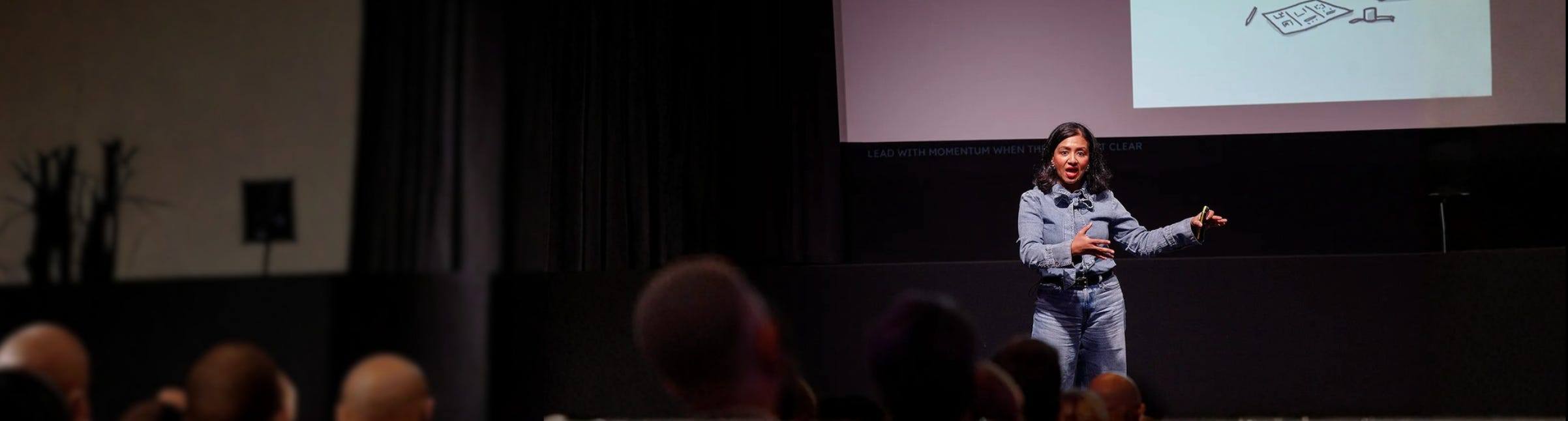
Hi, I’m Ariba Jahan.
As an immigrant, bioengineer turned product and CX executive with partial hearing loss, I’ve come to believe that the most interesting things happen at the edges of worlds, where science, technology, business, society and human experience collide.
Unmissables explores those collisions and the unexpected connections they create, uncovering ideas that shape how we create, work, and live.
Follow Unmissables on Substack for new essays, or learn more about my work.